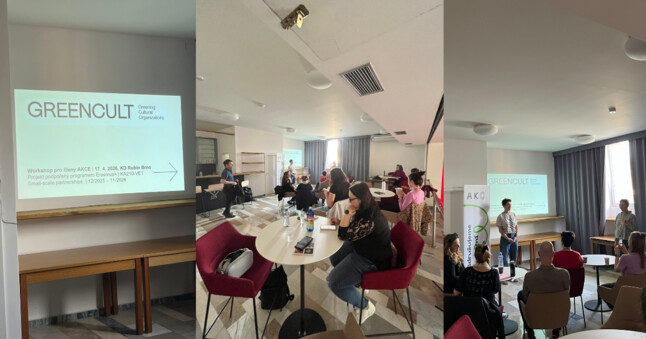
On 17 April 2026, the National Institute of Culture (NIK) in cooperation with the Association of Cultural Centres (AKCE) organised a professional seminar on environmental sustainability in culture in Brno. The seminar took place as part of the program of the AKCE national meeting. Representatives of cultural centres had the opportunity to share their experiences and learn about the basic principles and approaches to implementing environmental measures in practice.
The workshop was the first public activity of the GreenCult project, supported by the Erasmus+ programme. The project is implemented in cooperation with the organisation Motovila (Slovenia) and the networks of cultural centres KUDUS (Slovenia) and AKCE (Czech Republic).
Sustainability as an operational discipline
In his presentation, Viktor Třebický (CI3) placed the topic in the broader context of climate change and introduced a practical, non-ideological approach to sustainability. Drawing on data about rising CO₂ concentrations and global temperatures, he demonstrated that political debates about climate do not change the physical reality facing cultural institutions: their buildings consume energy, and energy costs money.
"Sustainability for me is not a belief or ideology. It is an operational discipline — and often the cheapest path to a more resilient institution and satisfied visitors."
— Viktor Třebický, CI3
The presentation focused on where real impact originates. Buildings in the EU consume approximately 40 % of all energy, while 75 % of the building stock has poor energy performance. Cultural centres face a specific challenge: irregular operation, large halls, and one-off energy-intensive events. The key areas for environmental action are energy and HVAC, lighting, everyday operations and event management.
Třebický drew a clear distinction between measures with genuine impact and those that tend to be overestimated. Organisations frequently focus on waste sorting while neglecting heating — yet the environmental and economic priority should be the reverse. Practical first steps include adjusting temperature settings and time schedules, switching to LED lighting, and monitoring consumption by month, zone and individual event. Czech examples — the National Theatre in Prague (over 50% reduction in energy costs following energy management modernisation) and the Prague Congress Centre (a photovoltaic system covering approximately 10% of annual electricity consumption) — demonstrate that significant savings are genuinely achievable in the cultural sector.
Sustainable events: lessons from the film industry
Miroslav Vlček (Platform for Sustainable Audiovisual Production, PUAV) also shared his experience at the seminar. Using the example of the Czech film industry, he showed how sustainability principles can be applied to the organisation of any cultural event. PUAV has been operating since 2024 and its members include Czech Television, FAMU and major commercial broadcasters. The platform has developed 13 binding principles of sustainable film production — covering energy supply, transport, catering, waste and a final report.
The most significant single measure for outdoor or location-based events is the switch from a diesel generator to a mains electricity connection. Where the event date is fixed, Vlček argued that a connection should always be sought: a generator produces approximately seven times more CO₂ emissions per unit of energy than the Czech electricity grid, and costs two to three times more. Using a concrete example, he demonstrated that for a production consuming 150 kWh per day, switching from a generator to a grid connection reduces emissions from 374 kg CO₂ to 55.5 kg CO₂, while cutting energy costs from approximately 4,200–4,500 CZK to 900–1,350 CZK.
Vlček also addressed the use of carbon calculators as decision-making tools — not communication instruments — and warned against greenwashing: publishing sustainability claims without underlying data or systemic change. He emphasised that sustainability must be planned, not improvised on the day: catering requirements, waste management plans, transport arrangements and power connections are all decided during the preparation phase. A single designated person responsible for sustainability in each organisation or at each event is essential.
What participants need
The seminar also included a discussion among participants, from which the following needs emerged:
- Practical examples from comparable organisations — not large flagship institutions, but centres of a similar size and with similar constraints.
- Sharing of both good and poor practice, so that organisations can learn from real experience.
- A directory of experts, consultants and providers of environmental audits who can advise on specific buildings and operations.
- Guidance on the practical use of carbon calculators, including how to interpret results and identify the next steps.
- Strengthening of international cooperation — within the project with Slovenian partners in the KUDUS network, with the aim of exchanging approaches across the two countries.
Speakers
- RNDr. Viktor Třebický, Ph.D.; CI3 — Centre for Environment and Sustainability
- Mgr. BcA. Miroslav Vlček, Ph.D.; Platform for Sustainable Audiovisual Production (PUAV); Ostrava University